Better Understanding Us
Looking at our Perth Community Through a Different Lens
Introduction
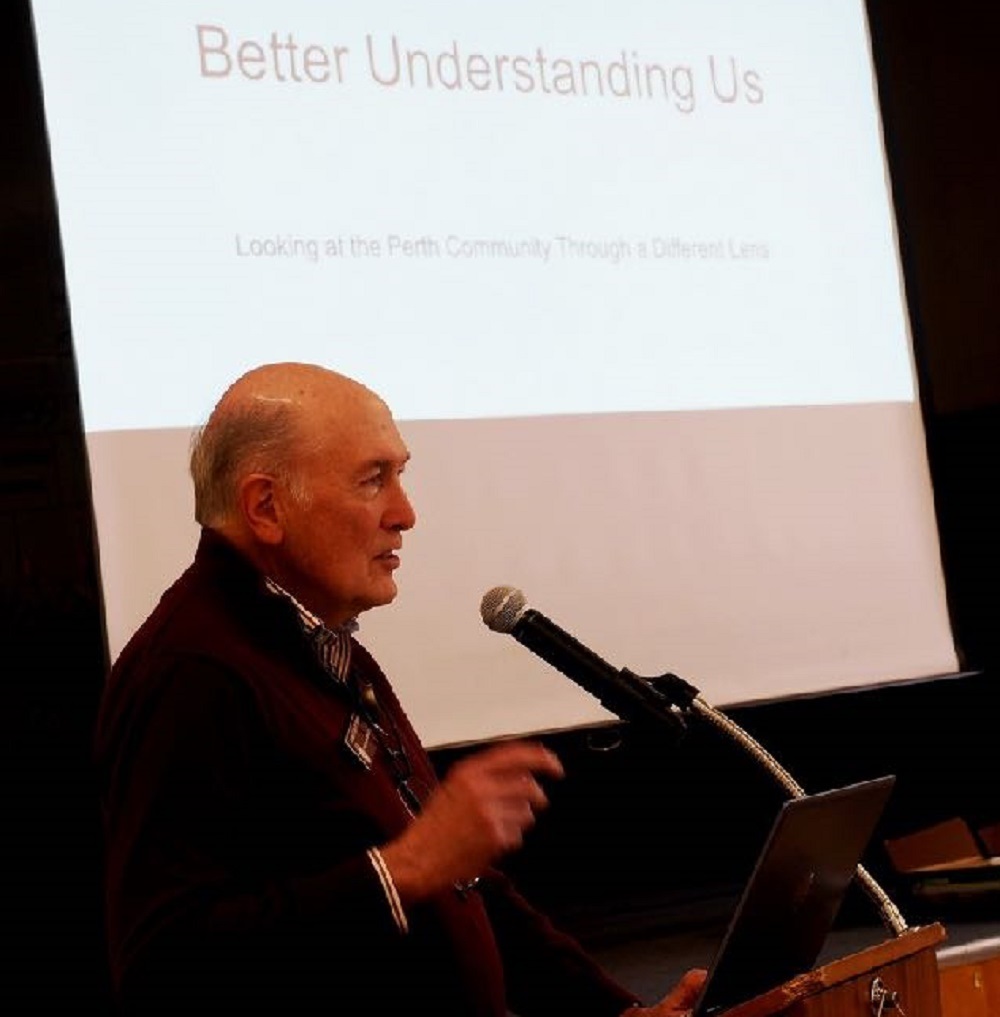
It seems everywhere we look there are demonstrations of the need for change. Be it, delivery of healthcare, municipal, social and educational services; or for managing our impact on our environment, climate change realities and demographic evolution. All of these impact on our living successfully in community our economic viability and sustainability.
Back in December we had a program that focused on Seniors Living Successfully in Community and when I thought about how we might realize some of the programs and services opportunities that are out there asked myself is there a role for community governance (municipal Government) in giving this light. I believe there is, but I immediately shuddered at the thought of having to marshal four municipal governments, and their councils to give it life.
It is my belief that as Community we need to adjust how we identify as a community and how we present ourselves to, and are understood by, senior government levels, be they County, Provincial of Federal, to successfully enable a sustainable viable future.
I feel a Better Understanding of Us would help us adjust, as community, to accommodate necessary changes, enabling the services we need and the economic environment supporting ‘Community’. I hope in 30-40 minutes to prompt a much longer contemplation of how we are might adjust our municipal governance for/to the 21st century.
Elements of Concern
Sustainable, Sustainability; Integrated, Integration; Efficient, Efficiency; Collaborative, Collaboration, Highest and Best Use; Smallest Possible Carbon Footprint; Inclusive vs Exclusive; Viable, Viability; Reconcile, Reconciliation: People and Person Centred; Compassionate; Empathetic; Caring; equalling Healthy Community
Looking At Greater Perth Through a Different Lens
I live in a community of +/- 26,000 people. From here on in, the reference will be to we and us because I think we share the same reality and community identity.
This community of 26,000, shop in the same stores, we use to the same lawyers, accountants, doctors, dentists, chiropractors, and physiotherapists, attend the same acute care hospital, use one hospital- based ER and the same Long Term Care Facilities and go into and out from the same MRI and CT scanner.
We use the same paramedical service, police force, social services department, rent geared to income housing service, the same mental health services.
Our Fire and Rescue services, is it time for a rethink? Two services housed and based in Perth both on the same side of the rail line, a sub-division in Maberly and a multi-station Highlands service, all part of a Lanark County Mutual Aid Agreement.
Our kids play on the same minor sports teams, swim in the same indoor pool and on the same competitive swim, soccer, baseball, basketball, curling and hockey teams. Our kids attend a variety of neighborhood elementary schools, the same public and separate, senior elementary and high schools. Our pre-school kids use the same daycare services. We are served by the same children and youth services.
Our families use and support the same food bank (yes, a Pantry in Lanark). We do community gardens and farmers markets together at more than one location.
Our adults and kids use the same library (largely, there is also a library in Lanark Village that probably should be connected to the Perth Union, but that would take four municipal councils to agree), we perform in the same community theatre groups, sing in the same choirs and play in the same Citizen’s Band. We inter attend and belong to the same churches, support the same charities, the same senior’s groups, book clubs and service clubs. We play on the same golf courses and on the same curling rink, we have one Community Foundation.
Heck we even play bingo together and on October 31st we have this ritual where we load our kids up and head to Perthshire, Perthmore, Carsonview, Mather, Robert, Argyle, Decaria and those kids’ go door to door followed by the spooky Crystal Palace experience all in support of our local dentists.
We belong to the same struggling Canadian Legion (yes there is a branch in Lanark Village), we do Parades, Remembrance Day and Canada Day together.
We have one Historical Society.
We provide and support a vast array of volunteer services together, from meals on wheels to assistive devises pooling, our Hospital Auxiliary and service clubs.
What we don’t do together is municipal governance, economic development, land use planning; infrastructure planning and Healthy Community development or address affordable housing challenges.
And we too often fail to acknowledge our total interdependency.
The cornerstones of a sustainable community
What are the cornerstones of a sustainable Community?
Jobs, a reasonably self-sustaining economy
Dry, clean, warm, and healthy Living Accommodations
Comprehensive Education facilities to the greatest realizable potential
Comprehensive Healthcare to the greatest realizable potential
Supportive Social and Recreational Services and Facilities
And Hard Services Infrastructure, Water, Heat, Light, Electrical Power, Communications, Transportation, Environmental Services, Schools, Hospitals and yes Roads
None of the four municipalities of West Lanark, the greater Perth Community, is sustainable on its own.
Our community is growing and will continue to grow at, what potentially could be an accelerated rate.
Many factors contribute to that inevitability; our aging Canadian population retiring to small town (community) Ontario and for a variety of other reasons both lifestyle and economic.
21st century communications also mean young families can work remotely or from home and experience a better small town, rural, quality family life that, can be less costly.
But that statement, relative to us, has a BIG IF. Do we offer the services and supports that will attract them?
Political realities and climate change in many countries has, of necessity, forced many on our little blue sphere, to look for a safer, sustainable quality of life. Can this help but accelerate?
Are we prepared to enable growth and evolution; to face the realities of a changing economy; facilitate it happening as four separate municipalities?
This growth opportunity/necessity, comes at a critical time for this community.
I first started assembling this presentation in the summer of 2023, at that time we had almost 100 unfilled positions at our hospital, our ER shut for several weeks in 2022 for this very reason. Our maternity service closed for 6-8 weeks in late 2022. We have an equal number of positions unfilled in our Long-Term Care facilities, and many more in our local construction, manufacturing and in our services community.
Our Education Infrastructure is at the end of expected life span. It can not be replaced in its present configuration.
Our Recreation Infrastructure has outlived its expected service expectations.
Our Hospital, the Perth Site, has entered into a redevelopment study process, a plus $100 million infrastructure investment, that will require us raising $10-15 million (the 10% portion the Province will not cover, plus the cost of the equipment furniture and fixtures to make it function. Do we address this challenge as four municipalities or as one Community.
The role of municipal governance
We also have the largest potential infrastructure investment in the history of our community presently in front of us, that has the potential to bring 3-4000 additional residents to our community in the form of the Golf Club development and several hundred apartment units in addition to it.
We are an aging community. From 2016 -2021 the average age of a Perth resident increased from 50 to 58 years. Demographically that is like dropping off a cliff.
With age 65 the societal expected, retirement age, we are quickly aging out of workers.
We need more young people in our community, like yesterday.
Is this a challenge the Perth Community has the capacity to address? Is there a municipal governance responsibility/role? I believe a very large role. As we currently do municipal government, do we have the ability to respond?
For our community of 26,000 we have 4 municipal governments.
This is not serving us well.
We almost entirely occupy the Tay Valley Watershed and have significant presence in the Mississippi Valley Watershed.
The Tay River is the life blood of/for the place in our community where +80% of our jobs are located, where we go if we are needing ER or hospitalization, where our high schools and community college, most of our recreation infrastructure and social and professional services locate.
Separated as we are among 4 municipal jurisdictions, we have troubling parochial attitudes about each other, akin to family arguments over bedrooms
I think we could benefit from a reality check, an acknowledgement of the contributing elements that enable our community. I hope recognizing and Better Understanding Us, will foster a better understanding among us enabling our greatest potential and to enable sustainability.
I am going to digress for a moment
Four municipal governments
We have only ever sent Conservative politicians to Queen’s Park. So, I am comfortable in saying we have conservative leanings. Conservative to me equates to small government, less red-tape, efficient use of tax dollars, ease of doing the business of government, but conservative also suggests resistance to change.
For 26,000 people we have four municipal councils, comprising 28 elected council members. This is more that one for every thousand people. At this rate of representation, Ottawa city council would be comprised of one thousand elected members. How would that work? And to harden the perspective, the City of Ottawa is a ‘single tier’ municipality, there is no County Governance layered on top of it, as we have.
Each Municipality has a grid boundary surrounding it. A grid established almost 200 years ago, when nobody lived here. There is almost no connection between this grid and how, 8-9 generations later, the use of our geography we developed it into.
We have four official plans, which Provincial mandate requires to ‘update’ every 5 years. These updates cost us between $50-150 thousand dollars each, each time.
We have 4 Zoning By-laws, four municipal planning departments.
Municipal Planning and the Provincial Statute Laws, underpinning our planning process, are extremely complex, the depth of knowledge and experience required to administer, is considerable. Just consider the recent changes Bill 23 is introducing upon municipalities. Do we need or can we justify engaging as one community, engaging in this process four times? Can we rightfully expect to have our already stretched planning staffs responding with expert confidence, adroitly, consistently, across our community when this divergence is what we expect/require them to do? Could we be better served if one staff member from our four departments were assigned Bill 23 preparedness for all of us?
Planning Offices (departments) intimately influence social policy, could we benefit our community social needs by viewing our community geography collectively and planning our use of it collectively?
Would we be better served by a professional planning office of 8, or 4 planning offices of 2?
We have four building permit and inspection departments. Staffing four services has proved to be challenging administratively and from a human resource perspective. This impacts our ability to get construction consistently and uniformly enabled. Could life be made simpler for our construction trades and property developers with a single set of expectations and practice? Collectively could we accommodate/enable more growth if we did growth together?
We have four finance departments, four tax billing and collection departments, four separate accounting systems to operated and maintain. Four financial statements to audit. Four provincially legislated municipal reporting process to comply with annually.
Can we do better?
Our community in the 2021 Census
So, do we see ourselves accurately/fairly as community and why do I ask?
Are we collectively understanding that healthcare, education, jobs, and supporting infrastructure are the foundational elements enabling our existence as community and that none of us alone can rise to the challenge?
Are we indeed four separate, viable, self-sustaining municipalities?
If we are not why do we do perpetuate community governance as we do?
The statistics that follow, are taken from the 2021 Canadian Census.
Where do we live?
| Measure | Lanark Highlands | Tay Valley | Drummond N. Elmsley | Town of Perth |
|---|---|---|---|---|
| Population | 5737 | 5925 | 8083 | 6469 |
| Population growth 2016–2021 (%) | 7.5 | 4.6 | 5.3 | 9.1 |
| Average per year (%) | 1.5 | 0.9 | 1.06 | 1.8 |
| 10-year average (%) | 1.8 | 0.6 | 0.79 | 1.06 |
25% of our community live in the Town, 75% of our West Lanark population surround. How do we live? needs of the +40% of our population spending +30% of household income for housing? Are we meeting our community needs with less with 1% RGTI units of our total?
| Measure | Lanark Highlands | Tay Valley | Drummond N. Elmsley | Town of Perth |
|---|---|---|---|---|
| Households | 3409 | 3750 | 3708 | 3395 |
| Living in single-family homes (%) | 94 | 97 | 94 | 65 |
| Occupied as principal residence (%) | 75 | 64.5 | 88 | 96 |
| Apartments | 70 | 30 | 50 | 1230 |
| Rent geared to income: seniors | 0 | 0 | 0 | 97 |
| Rent geared to income: families | 0 | 0 | 0 | 36 |
All of our current RGTI units are in TOP so does that mean that low-income housing is a Town problem or is it a community challenge?
Are we indeed four separate, viable, self-sustaining equally participating municipalities?
Income and poverty
Is there income disparity in our community, where do the best off financially reside?
The best-off live-in Town, right?
| Measure | Lanark Highlands | Tay Valley | Drummond N. Elmsley | Town of Perth |
|---|---|---|---|---|
| Median household income | $81,999 | $90,000 | $98,000 | $63,200 |
| Households with income above $150,000 | 380 | 445 | 795 | 305 |
| Households with income below $25,000 (%) | 8.8 | 5.5 | 5.3 | 13.1 |
| Households receiving EI benefits (%) | 1.5 | 1.1 | 1.0 | 0.9 |
| Below LICO after tax: age 0–17 (%) | 2.6 | 1.6 | 1.2 | 2.4 |
| Below LICO after tax: age 18–65 (%) | 3.1 | 3.0 | 1.8 | 6.0 |
| Below LICO after tax: age 65+ (%) | 1.4 | 0.9 | 0.9 | 1.2 |
Median Income is 16-35% lower for in-Town households.
84% of high-income households are outside the Town boundaries.
There are several comments to add to the Income Stats.
The Canada Child Benefit appear impactful reducing child poverty, a federal initiative.
Of our 18-65 adult population, the low-income levels in Perth are two to three times higher than the other 75% of the community population. Rent Geared to Income Housing is provided at a ratio of 7/3 seniors to families, yet the rate of LICO is 5 times greater for the 18-65 cohort. How is this right?
Age, children and schools
And what happens at age +65 to reduce poverty rates by 50-80%? It is called CPP, OAS, GIS, GAINS, Trillium Benefits and Pharmacare. And as a side note, those of us over 75, received a 10% increase in OAS in December 23 and, all over 65 (200,000 Ontarians) had GAINS benefits double to $166 per month. Ontarians under 65 saw a 5% increase in ODSP benefits. Does our society revere those over 65 and detest our poorest under 65?
Would a Universal Basic Income plan have a similar impact, reducing the poverty rate on our 18-65 population?
Another discussion, another time! I think we deserve it to our selves to run a variety of trials to answer the question however.
Is poverty a Town of Perth problem or a Perth Community challenge?
Are we indeed four separate, viable, self-sustaining equally participating municipalities?
Where do the younger folks among us live?
| Measure | Lanark Highlands | Tay Valley | Drummond N. Elmsley | Town of Perth |
|---|---|---|---|---|
| Average resident age | 52 | 57.2 | 50.8 | 58.4 |
| Children aged 0–17 | 1360 | 1290 | 2175 | 1270 |
| Public school children attending school | 126 | 110 | 164 | 1303 |
| School occupancy (%) | 45 | 36 | 44 | 78 |
| School building age (years) | 53 | 55 | 55 | 74–17 |
| Walking to school (%) | 14 | 7 | 7 | 26 |
| Walking to school (children) | 18 | 8 | 11 | 338 |
21% of our children live in TOP. 76% of our Public-School Children attend schools in the TOP.
Education and family needs
To me what is significant here is that for our community, our schools’ infrastructure is overbuilt, and it is aging. Except for The Stewart School in Perth, and St John’s Highschool our buildings are getting to the end of their life cycle. The Perth Family of Schools (UCDSB connotation) community is not unique (rural aging population, low birth rates). What is happening in Essex County (similar demographic) is the creation of Composite Schools (one campus, K-12 with Day Care services, this has recently happened in the Leamington and Kingsville communities.
Is our educational infrastructure not a challenge we should be accommodating together rather than as 4 municipalities with parochial interests?
Common to all property owners in our community is the rate of property tax (mill rate) we pay to support our education systems. The mill rate is identical whether our school is 36% occupied or 78%. We contribute equally to transportation cost whether our children are bussed or walk to school.
From an education services view point are we indeed four separate, viable, self-sustaining municipalities?
What % of our Households have Children and of those Households
| Measure | Lanark Highlands | Tay Valley | Drummond N. Elmsley | Town of Perth |
|---|---|---|---|---|
| Households with children (%) | 40 | 34.4 | 58.6 | 37.4 |
| Single-parent households (%) | 21.5 | 17 | 17.6 | 42.5 |
Remember back a bit we saw sizable differences in Median Household Incomes in our greater community.
It doesn’t appear that our ‘collective community’ is much different than the remainder of the UCDSB, where 24% of their students are living in single parent households, but what is happening in our community that sees 42.5% of single parent households reside in Perth and 17-21.5% in the other municipalities in the Perth Family of Schools.?
Is it faulty reasoning to suggest that when the high income households in our community experience marital breakdown that there is a substantial reduction in per household income; that maintaining two households for one family has a differing financial reality for one parent than the other, that perhaps results in leaving the 3-4 bedroom home for a two bedroom apartment, that the single parent wants/needs, schools, daycare, recreation, after school programs, full or part-time jobs, food bank, social and medical services within walking distance or a five minute commute.
Where in our community do those amenities exist? Is our single parent household reality a TOP problem or as a community could we be/do better facing it together?
Are we indeed four separate, viable, self-sustaining fully servicing municipalities?
Jobs and our local economy
Let’s switch gears.
What enables our economy in support of us living here?
Our agricultural economy is centred largely in DNE and to a lesser extent TV and LH
Where are the jobs in our community, where do we work and what do we work at?
Here are stats from the Lanark County Economic Development Strat Plan 2018.
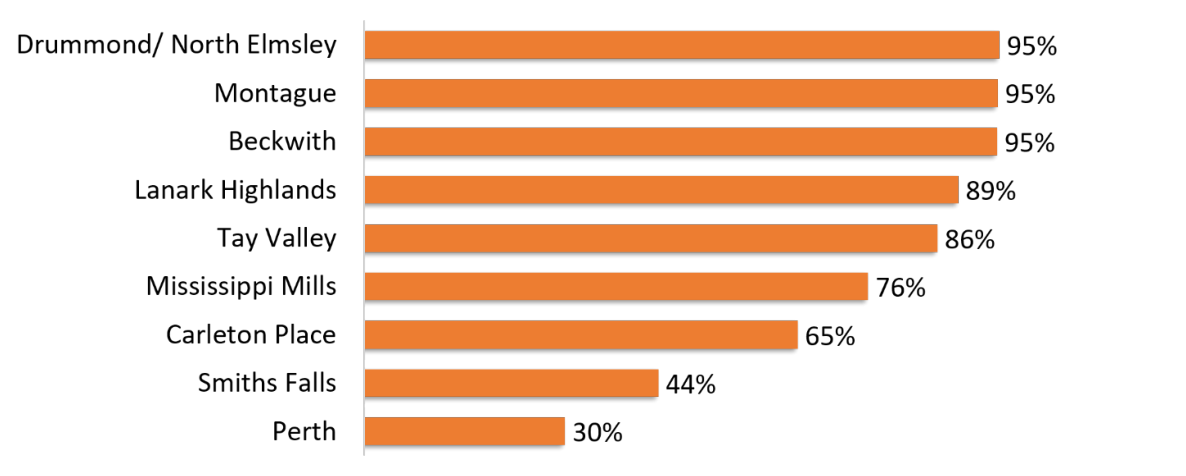
The question answered here is what % of us leave the municipality we live in for work in another municipality?
What are the Sectoral Job types and employed numbers in Lanark County?
Healthcare and Social Services 4026
| Measure | Employed number |
|---|---|
| Healthcare and Social Services | 4026 |
| Retail Trade | 3783 |
| Manufacturing | 2613 |
| Accommodation and Food Services | 1816 |
| Education Services | 1396 |
| Construction | 1294 |
| Public Administration | 1140 |
| Transportation and Warehousing | 876 |
| Professional Services | 746 |
| Administrative Support | 716 |
| Arts and Entertainment | 550 |
| Wholesale Trade | 478 |
| Finance and Insurance | 424 |
| Agriculture Forestry | 182 |
A common community purpose
At the time our municipal boundary grids were put in place 40 % of us worked in agriculture and forestry, things have changed with less than 1% now! Where are these, healthcare, retail, manufacturing, education, professional services jobs in our Perth community? Where in our community are the 4-500 job vacancies? 75% of the Perth Community rely on Jobs in one of our four municipalities. These jobs are necessary for us to live and receive needed services, for us to live in healthy community. So, as I observe us, we collectively have a community viability, sustainability, collaboration, efficiency, strategic planning and community development challenge.
Do we have common community purpose/objective when engaging provincial or federal infrastructure or services initiatives?
There are municipalities in Ontario that are adding population numbers each year greater than our present total combined population.
We are competing with these and other municipalities that restructured their community governance 30 years ago.
We are competing for everything from roads, bridges, schools, healthcare and recreation infrastructure; business, industrial development opportunities and services like daycare, family health teams and community development resources and hospital redevelopments or Seniors Living Successfully in Community programs.
The consequence four municipal faces, for one community is two-fold.
If you are a municipality growing by 25 thousand people a year and that municipality has none of the infrastructure they require, and the province is making a funding decisions between those with no school against those with a 70-year-old school or a small crowded 65-year-old arena to replace; guess what/guess where, resources are going to be allocated?
Secondly, we make it difficult for our provincial government to accommodate our collective needs when we too often don’t provide/present a single face.
Does the Town of Perth have a future infrastructure problem or services deficiency?
Is it not more likely to say that the Perth Community has an infrastructure challenge and services deficiency?
Are we indeed four separate, viable, self-sustaining municipalities?
Funding and childcare services
As a community do we maximize, to our collective benefit, Provincial/Federal Operational Funding Initiatives?
I am going to touch on three examples. In 2020 the municipalities of West Lanark, the greater Perth community, received $2,383,000 from the province in the form of ‘Municipal Modernization’ funding. Divided among our four municipal governments, the Town of Perth, with the vast majority of our community economic infrastructure and our healthcare and education services received the least. A Provincial Web Page describes the purpose of this funding; “Municipalities can use the funding to conduct reviews of service delivery and administrative expenditures to find efficiencies or implement a range of projects, including developing an online system to improve the local process for approving residential and industrial developments or setting up new shared services with neighboring municipalities.” Did this happen here? Was a collective improvement in our municipal services enabled?
Have we improved the processes to enable residential and industrial development, or will we continue to provide our community with four separate sets of services?
Are we indeed four separate, viable, self-sustaining municipalities?
This example is 4 years old, here are two graphic 2024 examples where our four municipalities face causes me concern.
County of Lanark Childcare and Early Years Services Plan 2024- 2029
https://www.lanarkcounty.ca/en/county-government/resources/Budget-and- Finance/Service-Plan-2024-2029.pdf
Quoting from the plan;
“This Service Plan will focus on the priorities and initiatives over the next five (5) years and will highlight how Lanark County will continue to make the child care and early years system a quality system that is equitable, accessible, affordable, inclusive, and sustainable.”
The plan identifies that our County level of Government has assumed coordinating responsibility for the 8 municipalities of Lanark County and therein lies a less than ideal bias.
The study takes an 8 municipalities view as opposed to a community view, or a childcare Systems view
The plan identifies that we have a deficiency of 1300 day care spaces in Lanark County.
What drew my attention to this report was an article in the Perth Courier Journal (this is not an endorsement or plug).
The article identifies that 19% of Lanark County children live in Mississippi Mills, 20% in Carleton Place and 6% in Perth, which reflects a, by municipality view.
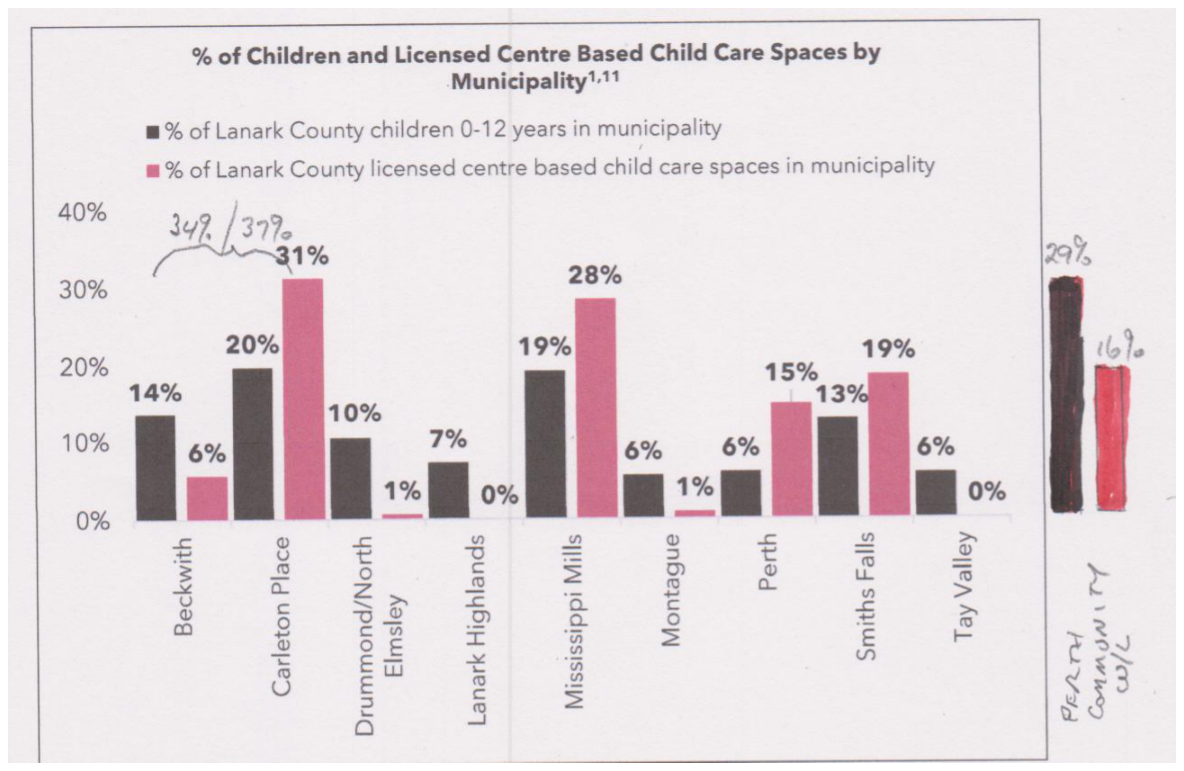
But through a ‘community’ lens, the Perth/West Lanark, the Perth Family of Schools community has 29% of the County’s children.
Childcare: the municipal view
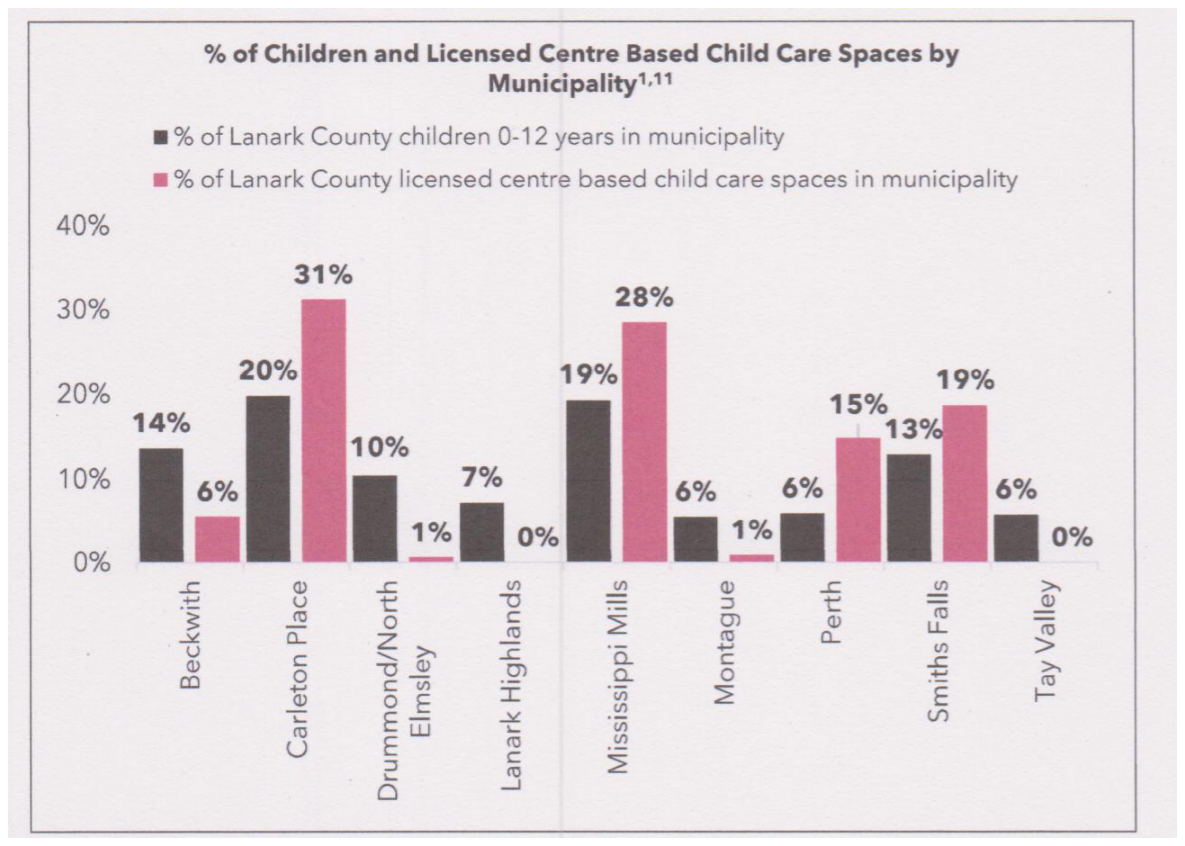
Almost 30 years ago, the Town of Almonte, the Townships of Ramsey and Packenham joined to form Mississippi Mills. They are the only municipality in Lanark County that presents a community face.
So, from/with a Municipal face, MM has 19% of the 0-12 year olds with 28% of the daycare spaces, Carleton Place has 20% of the kids and 37% of the spaces, and Perth with only 6% of the kids has 15% of the spaces. So obviously Perth has a disproportionate share of the daycare spaces, they/we are doing OK.
But with a community face,
Carleton Place/Beckwith have 34% of the kids and 37% of the spaces,
Smiths Falls/Montague have 19% of the kids and 20% of the spaces.
Mississippi Mils has 19% of the kids and 28% of the spaces
Perth/West Lanark, (the Perth Family of schools) has 29% of the kids but only and 16% of the spaces
Childcare: the community view
Non-traditional working hours
The plan also identifies Lanark County Residents working Non-traditional Hours, again look at the difference from a municipal view and a community view.
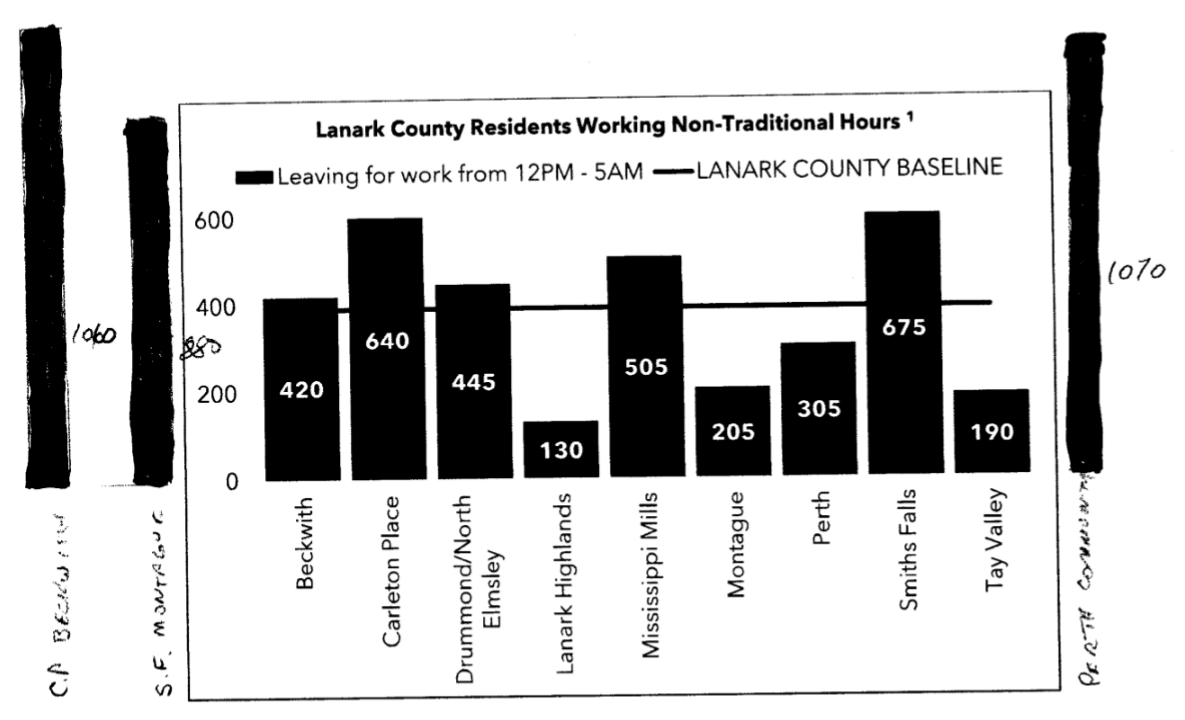
I make a point of reading the Lanark County Head of Council Annual reports each year. (I know, ‘get a life’.) Three of them were pretty good but one stood out, that of Christa Lowery of Mississippi Mills and in her report, she identifies a new allocation of 78 additional daycare spaces that will be available in 2025.
On the face of it, it appears that the municipality/Community with the best/highest ratio of kids to spaces is getting more while the rest are not. But first understand that this is just 78 new spaces against a shortfall of 1300, there is no question these spaces are needed and justified.
There is more to this than I have time this morning to speak to, but I offer that if our Perth Community wants to attract the young workers needed to sustain our community, this community needs to engage on how best to do respond to our serious deficiency of Daycare Services and they should reflect our significant need to support our high proportion of Non-traditional workers.
But a teaser is that for years, MM, CP and SF have been in the business of municipal daycare. 30 years ago, ToP was also in the daycare business. It currently is not and that is not the fault of the ToP it is a failure of the Perth Community. It is a long story.
Growth management: the municipal view
My third example centres on a recently released County of Lanark, Growth Management Study
What needs to be understood to begin with is that the governance controlling Land Severance and Subdivision Control (what is going to be built where) has been vested by the Province at our County Level of Government, not in our municipal planning office or councils. (as it is in Smiths Falls)
The County must regularly evaluate its policies regarding Growth Management and like daycare it is done for the municipalities, not communities.
Quoting from the report;
A goal of the Growth Management Study is to establish growth management principles and identify opportunities and options to consider for accommodating growth within the planning horizon.
•To ensure that Lanark County continues to plan for growth efficiently over the long term, it is necessary to study the current population and economic demands and anticipated projections regarding land needs through this comprehensive study process.
•The final study will serve as a comprehensive review to inform amendments to the County’s Sustainable Communities Official Plan (SCOP).
The next set of slides show how graphic representation can impact policy and perception.
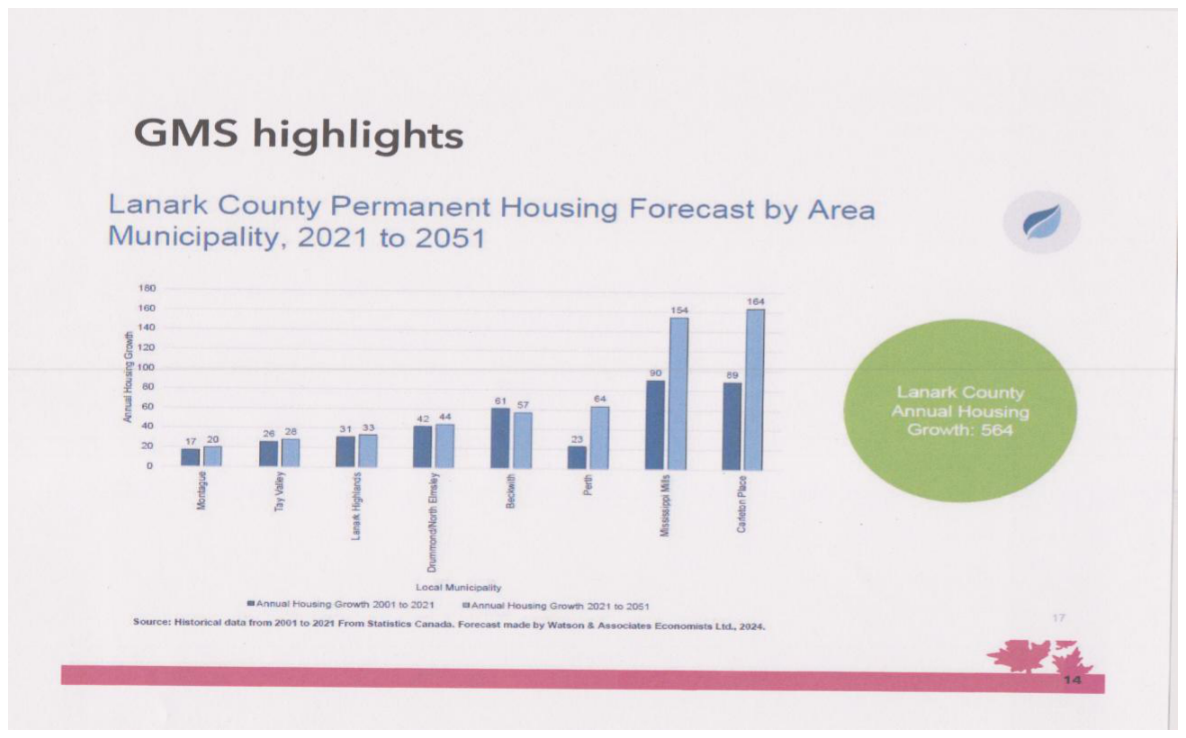
This first slide shows Housing forecast from a municipality view. On the face of it Carleton Place is the leader and just driving by on Highway 7 that is obvious particularly if Beckwith is added (a community
Growth management: the community view
view). But Mississippi Mills seems to be, by far second. Remember MM is the former Almonte, Ramsey Twp, Pakenham village and Packenham Township.
The next slide adds a community perspective adding an additional graphic combining the Perth community and guess which community is number 2?. Given that the Final Report will inform amendments to the County’s Sustainable Communities Official Plan, is the Perth Community fairly represented?
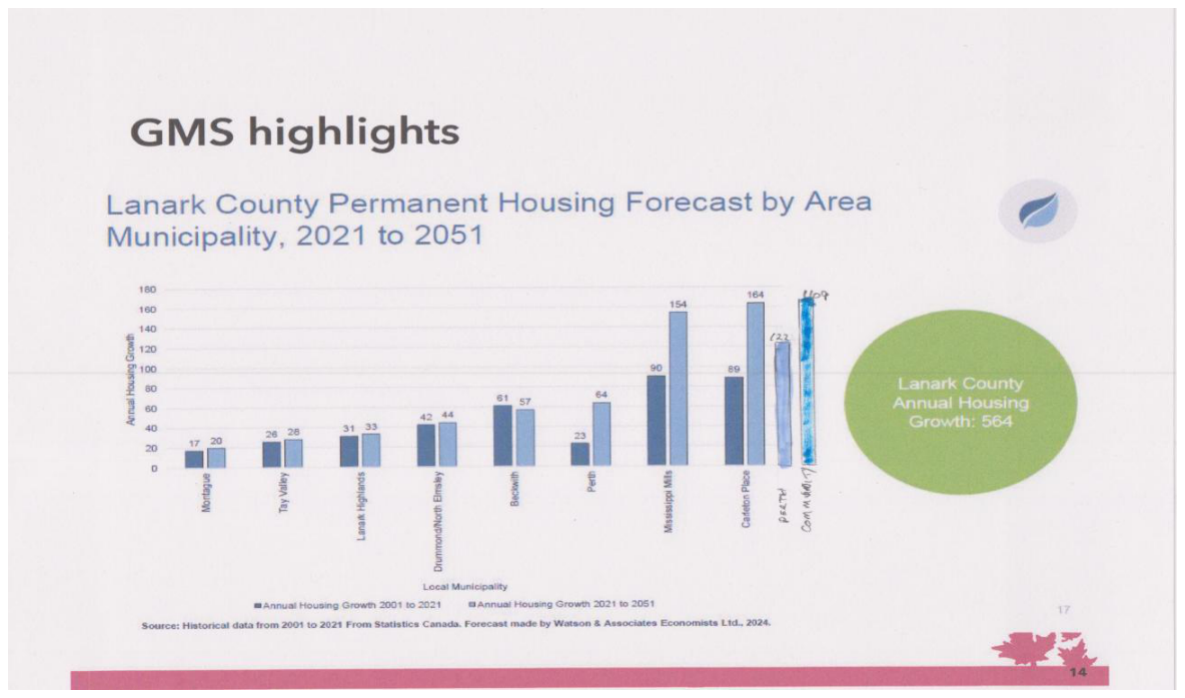
The first slide shows the eight municipalities. What is different in these representations from the Daycare slides is that these do not include Smiths Falls, SF is part of the County Social Services programs, but they are a ‘separated’ town for planning, subdivision control and land severance.
So, this concludes my community view versus municipality view and challenges tour.
Are we indeed four separate, viable, self-sustaining municipalities?
What are the cornerstones of a sustainable Community and are we able to address them through a community lens versus four competing municipalities?
Jobs, a reasonably self-sustaining economy. Should we be doing Economic Development as one?
Dry, clean, warm, and healthy Living Accommodations, are we collectively responding to our housing challenges?
Comprehensive Education facilities to the greatest realizable potential, do we have a common vision?
Facing our future together
Comprehensive Healthcare to the greatest realizable potential, we have huge challenge before us will we face them as one community?
Supportive Social and Recreational Services and Facilities, Do Daycare, Rent Geared to Income Housing, low income household and Seniors living Well in Community needs be collectively enabled?
Hard Services Infrastructure, Water, Heat, Light, Electrical Power, Communications, Transportation, Environmental Services, Schools, Hospitals, Recreation Facilities and yes Roads, we all have a stake in.
So, as I observe us, we collectively have a community viability, sustainability, collaboration, efficiency, strategic planning and community development challenge. How do we best address the opportunity?